
Last updated August 26, 2026
Free on-site gate assessment - hinges, posts, and your LiftMaster or Nice gate operator checked before anything is quoted
The assessment is free and the quote is the invoice.
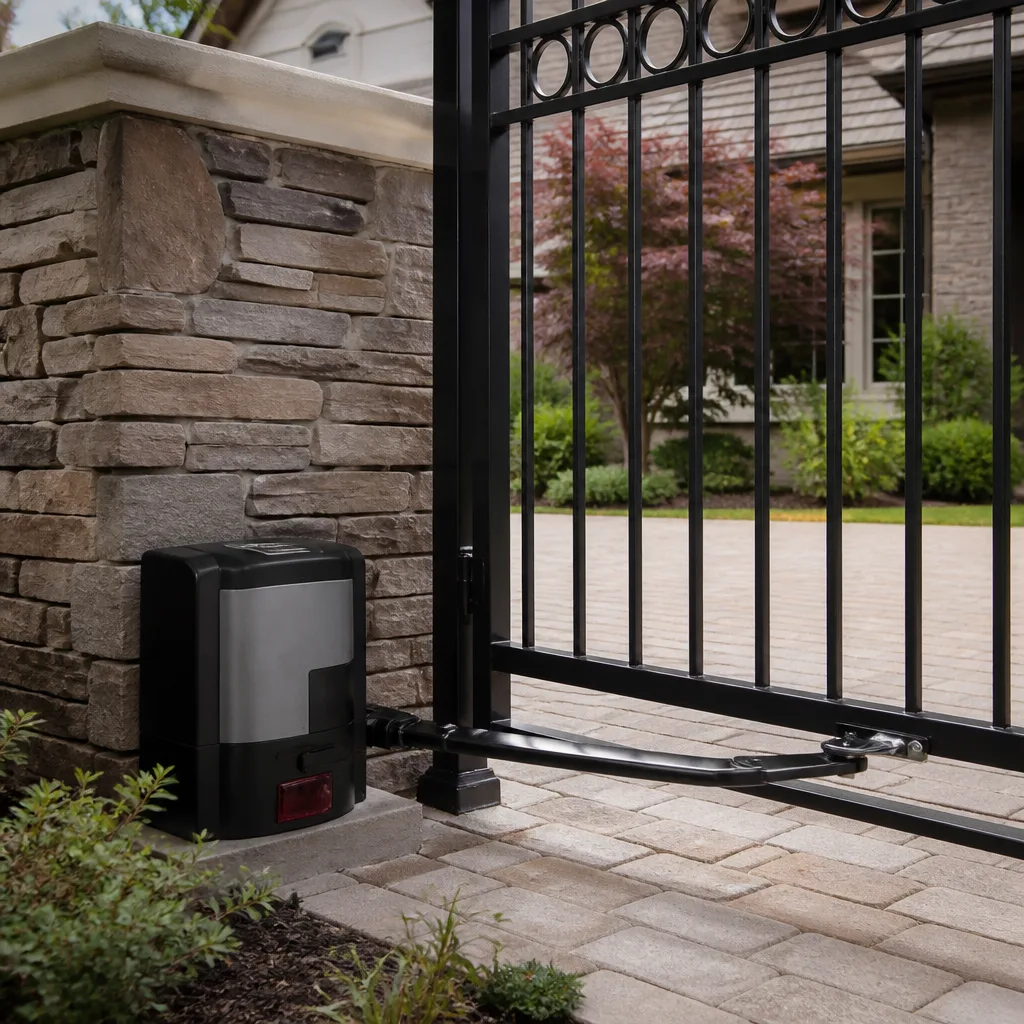
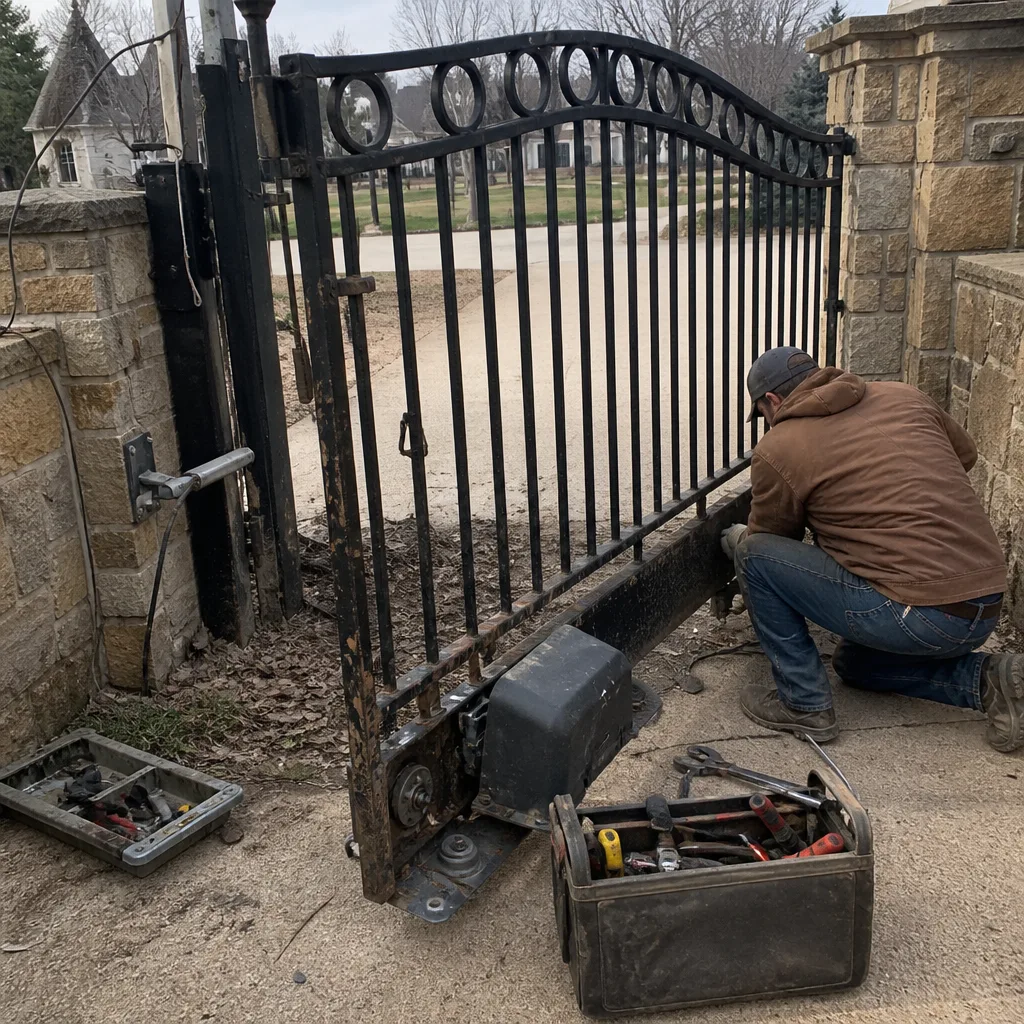 Before
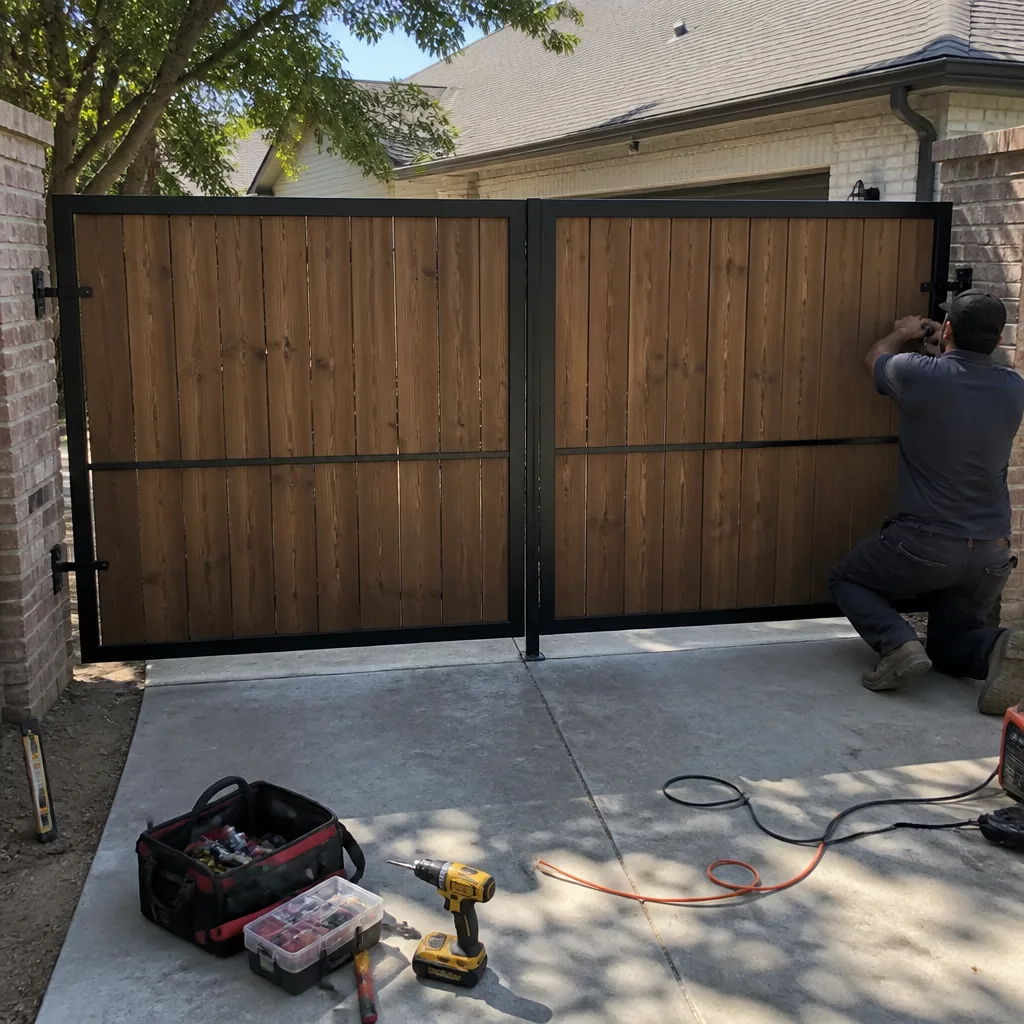 After
After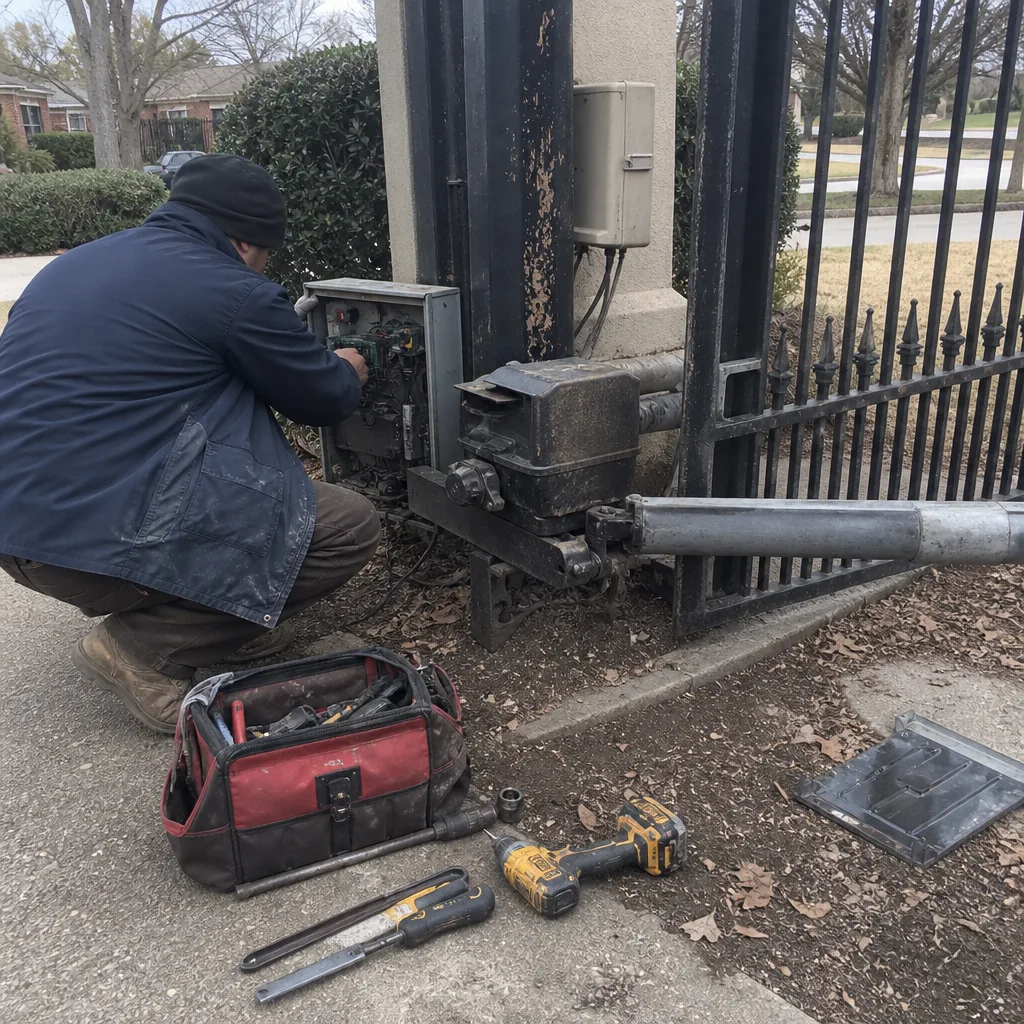 Before
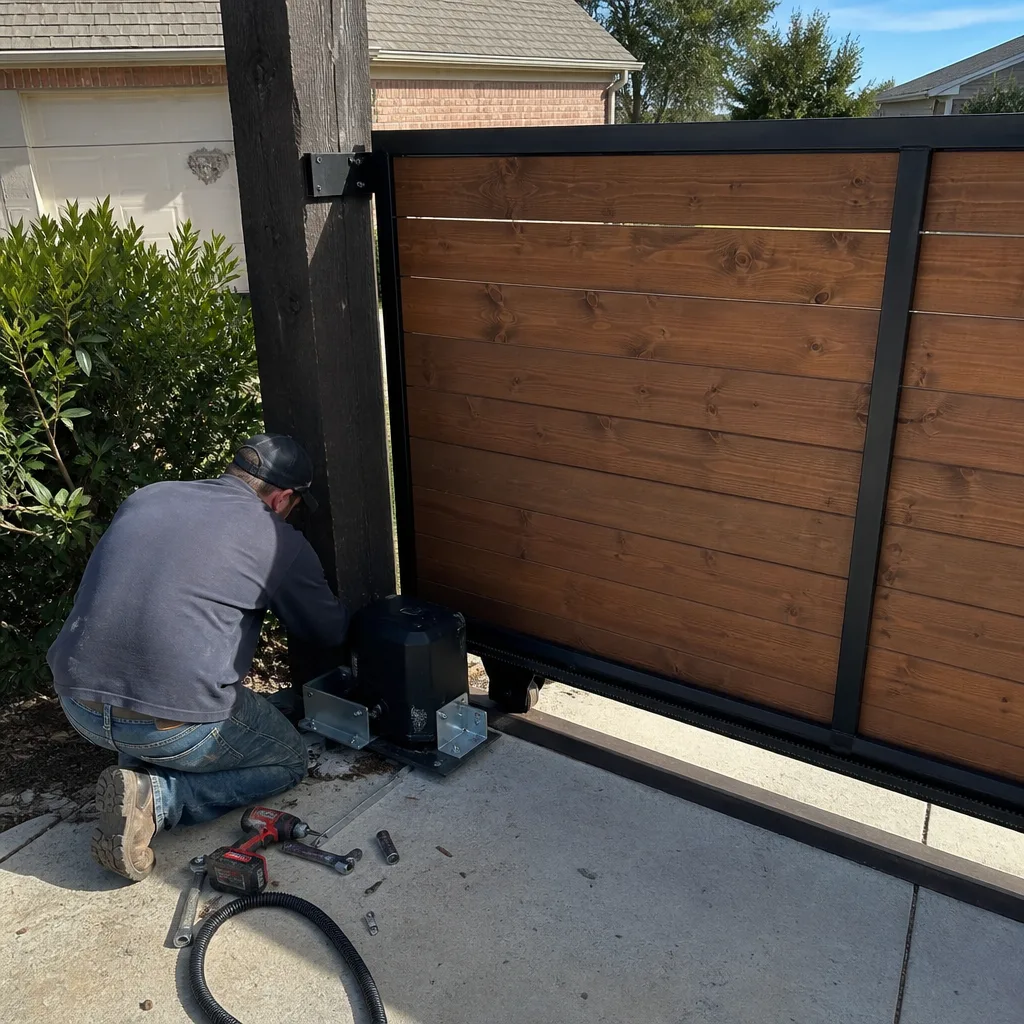 After
After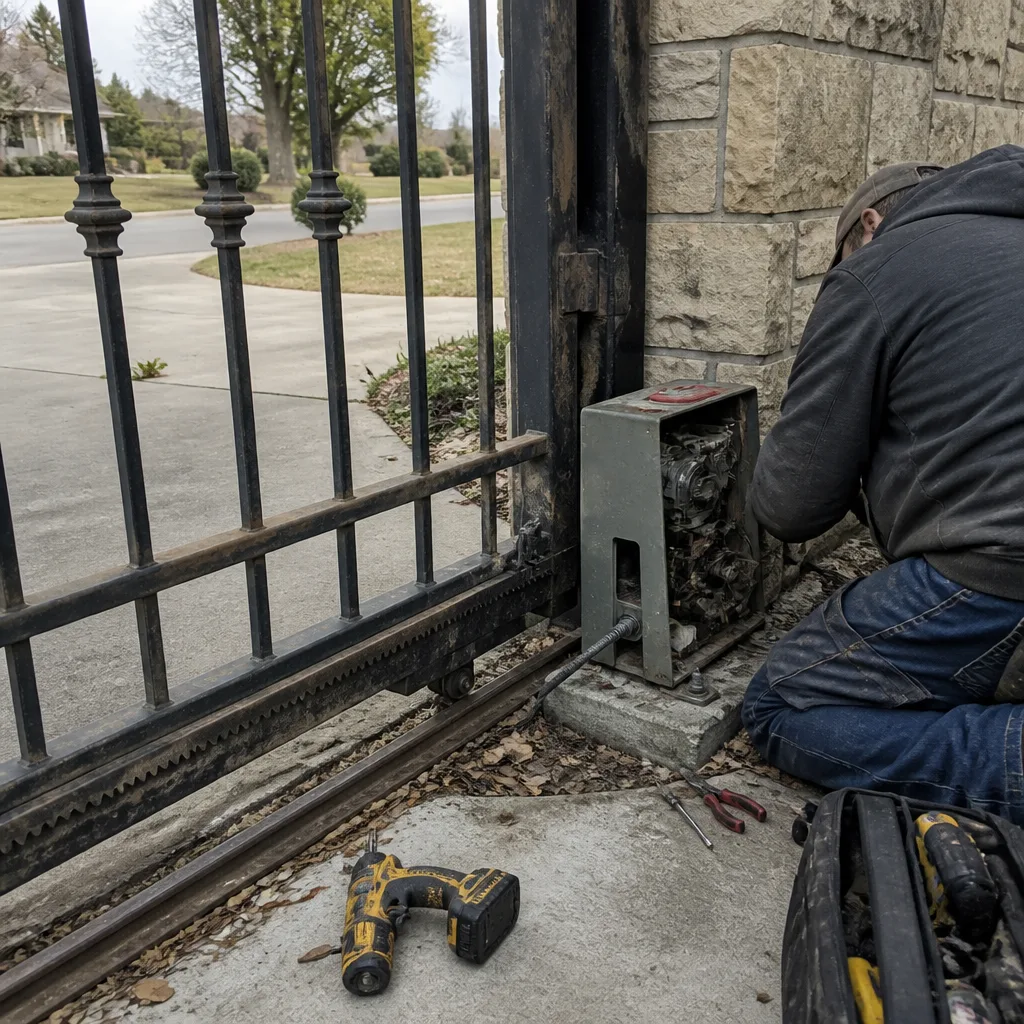 Before
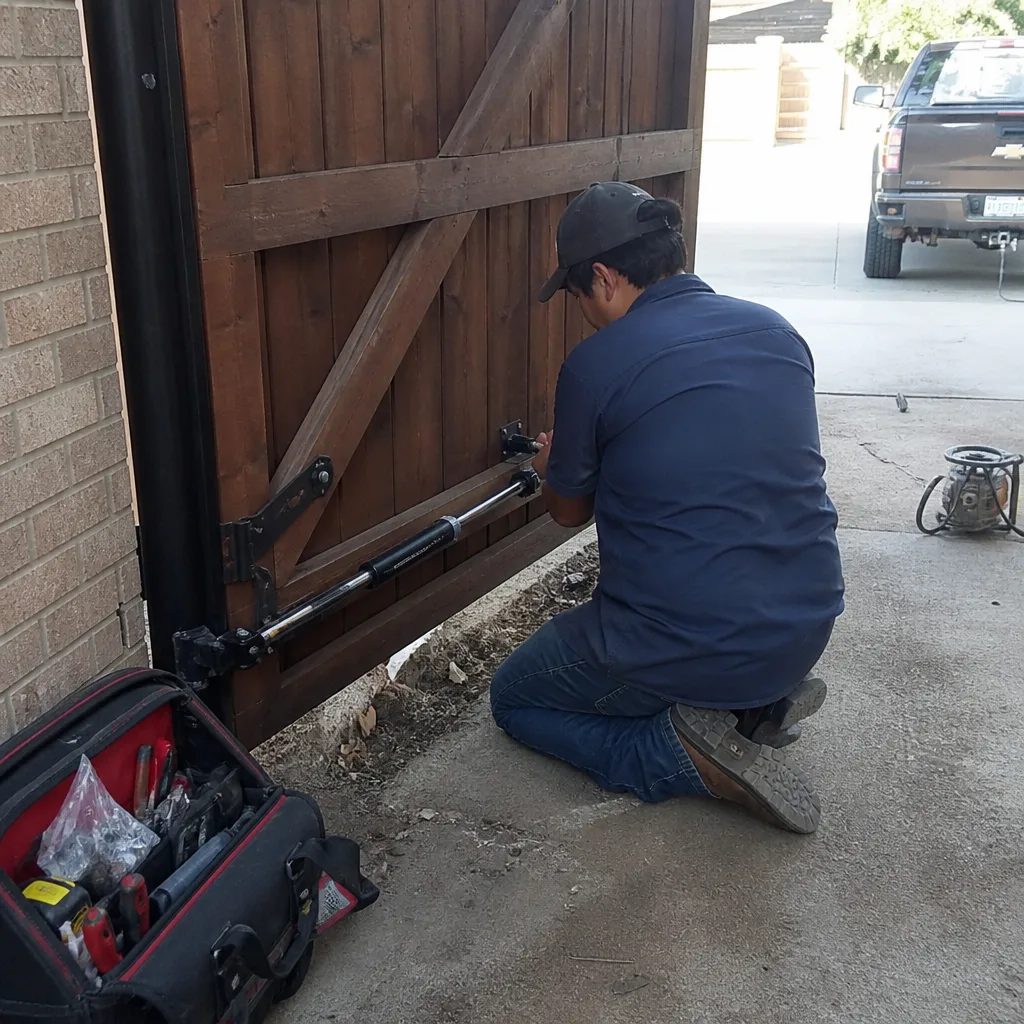 After
AfterGate Repair Warning Signs: A Prosper Homeowner’s Reference Guide
A gate that pauses for half a second before reversing direction is not “just doing that.” That pause is the opener working against misalignment it was not designed to fight. Six months later, the motor is burned out and someone is asking why the opener failed when “it was working fine.” This guide is about those early signals. The ones that have been quietly building for months before anything breaks visibly. If you live in Prosper and your gate moves even slightly differently than it did last year, what follows will tell you what that change means, what it will cost if you wait, and which symptoms you can watch for with nothing more than a tape measure and ten minutes of your time.
Quick Answer
The gate repair warning signs that actually predict a failure in Prosper are a pause before the gate reverses direction, a metal-on-metal scrape near the hinge post, rust bloom at a weld line, intermittent operation that comes and goes, and a sag of more than one inch at the latch end. Any one of these means a component is already working harder than it was designed to. None of them fix themselves. And in North Texas clay soil and summer heat, they progress faster than most homeowners expect.
Table of Contents
- The Sounds That Mean Something Specific
- How to Measure Gate Sag With a Tape Measure
- Why Intermittent Operation Is More Serious Than It Looks
- Rust Bloom at a Weld Line Is Not Cosmetic
- How Fast Warning Signs Progress in Prosper’s Climate
- The Visual Check Most Homeowners Walk Past Every Day
- Opener-Specific Warning Signs That Get Ignored
- Hinge Post Warning Signs You Can Check From the Driveway
The Sounds That Mean Something Specific
Most people describe a gate problem as “it’s making a noise.” That’s not enough information to act on. The specific sound tells you where the failure is building and what part is wearing. Here is what we’ve learned in our years of gate repair in Prosper.
A metal-on-metal scrape that happens at the same point in the travel every time means the gate has shifted on its hinges. The panel is no longer clearing the latch post or the ground by the same margin it was when it was hung. That scrape is the gate telling you it’s working against friction. Friction is what kills openers. The gate costs pennies to adjust. The opener it burns out costs hundreds. Fix the panel without the post and you’ll fix it twice.
A rhythmic clicking, especially on a chain-drive or gear-driven opener, usually means a worn gear or a chain that has stretched beyond adjustment. The click is the drive system slipping one tooth at a time. That’s not the chain “settling in.” That’s a gear with no teeth left in one spot, or a chain that has reached the end of its adjustment range. Running it past that point scores the gears and turns a $150 part into a $400 replacement.
A low hum under load, the kind you feel through the keypad more than you hear, happens when the opener motor is drawing more current than it should. It’s working against a gate that has gotten heavy - usually from water in the frame, a sagging hinge post, or a wheel that has stopped rolling and started dragging. In our experience with opener brands like LiftMaster and Mighty Mule, that hum is the motor asking for help. Left alone for a North Texas summer, the windings overheat and the motor dies quietly.
Here is the rule that matters in Prosper: if you can hear the gate before you can see it move, the sound is not cosmetic. It’s a diagnosis.
How to Measure Gate Sag With a Tape Measure
Gate sag is the single best early predictor of a repair bill, and it takes ninety seconds to check. A gate sags in the hinge post, not in the middle - and that is where we start. If the panel itself is straight but the latch end is dropping, the problem is rarely the gate. It’s the post or the hinges carrying it.
Here is the number to remember: one inch. If the latch end of your gate sits more than one inch lower than the hinge end when the gate is closed, you have a structural issue forming. Not a cosmetic droop. A structural issue.
How to check it, step by step:
- Close the gate fully. Look at the gap between the bottom of the gate and the ground at the hinge end.
- Move to the latch end. Measure or estimate the same gap there.
- Subtract. If the latch-end gap is more than one inch smaller than the hinge-end gap, the gate is sagging.
- Open the gate halfway and look at the top rail. A straight gate that sags will still show a straight top rail, but the whole plane of the gate will be tilted.
- Check the hinge post itself. Put a level on the post, not the gate. If the post leans even a few degrees toward the latch side, the gate didn’t sag. The post moved.
Now, what’s tolerable and what isn’t. A sag of under three-eighths of an inch on a gate under twelve feet wide is within normal settlement, especially on a gate that’s been up for five or more years of Prosper’s wet-dry clay cycles. Between three-eighths and one inch, you should be watching it. Over one inch, the gate is already loading the opener wrong, the latch is binding, and the hinge hardware is wearing unevenly. Over an inch and a half, the wheels are dragging if you have them, and the opener is working against a gate that wants to fall. That’s the point where a repair-first shop and a replace-everything shop part ways. We’d rather weld and re-hang.
Why Intermittent Operation Is More Serious Than It Looks
Homeowners treat a gate that works “sometimes” as less urgent than one that stopped working entirely. That instinct is backwards. A gate that quits working completely has a clear failure. A gate that works intermittently has a failure that is building, hiding, and getting worse every time it happens. Worse, it’s teaching you not to trust your own gate.
In Prosper specifically, we see three causes for intermittent operation more than anything else: thermal expansion, soil movement, and moisture in the electronics.
Thermal expansion is the big one. A steel gate in a Denton County summer reaches temperatures well above 120 degrees at the surface. The metal expands. If the gate was hung with clearance that’s tight at 70 degrees, it’s binding at 110. The opener senses the resistance, trips the safety circuit, and stops. An hour later, when the gate cools down, it works fine. That’s not an electrical gremlin. That’s a gate that was hung too tight for Texas.
Soil movement is the second culprit. Prosper sits on expansive clay. It swells when wet and shrinks when dry. Your hinge post is set in that soil. If the post is not deep enough or set in concrete below the frost line, the post moves with the clay. Some days the gate lines up. Some days it doesn’t. The gate didn’t change. The ground did.
Moisture in the electronics rounds out the trio. Humidity and sudden temperature swings cause condensation inside control boards, keypads, and limit switches. A marginal solder joint or a corroded terminal will pass current sometimes and fail others. That’s the most dangerous kind of intermittent problem, because it usually precedes a short that takes out the board entirely.
If your gate works sometimes, call before it becomes “not at all.” The intermittent phase is the cheap phase.
Rust Bloom at a Weld Line Is Not Cosmetic
There is a visual check at the weld points on a steel gate frame that most homeowners walk past every day. It takes closer eyes than a glance from the driveway. Here is what to look for.
Rust bloom at a weld line is not surface patina. It’s the weld failing from the inside out. A weld on a steel gate is the strongest point on the frame when it’s done right and the first point to fail when it isn’t. Why? Because the welding process changes the metallurgy of the surrounding steel. The heat-affected zone, the narrow band just beside the bead, is more brittle than the base metal. If the weld wasn’t ground and prepped correctly, or if the frame was painted without proper primer, moisture gets into the micro-cracks right there and starts working.
What you are looking for is a specific pattern: a line of rust that follows the weld bead, with tiny flakes or blisters lifting the paint right at the seam. That pattern means water is inside the joint, not just on it. Once water is inside, the rust is spreading through the weld throat. The joint is getting weaker every time the gate opens and closes, because every cycle flexes it.
On a welded steel gate frame, there are typically eight critical weld points: four corners, two mid-rail joints, and two uprights where they meet the hinge side. Walk your gate and check those eight points. What you are looking for is rust that follows the weld line itself, not scattered surface rust. Scattered surface rust can be sanded and painted. A rust line following a weld means the joint is compromised and will eventually crack. In Prosper’s humidity and rain seasons, once that bloom starts it takes months, not years, to reach a structural crack.
If you catch it early, the fix is on-site welding at the seam, re-priming, and painting. If you catch it after the crack, the gate is out of square and the repair is a complete re-weld. This is where Gatewood Fence & Gate home repair-first philosophy comes from. Hal has been welding gates in his driveway since 2001, because he’d rather fix a joint than replace a panel that’s still straight.
How Fast Warning Signs Progress in Prosper’s Climate
North Texas is not forgiving to gate hardware. The clay soil moves more than the gate does. The summers bake the metal and the electronics. The spring storms saturate the ground and then the summer bakes it into brick. Here is a realistic timeline for how fast the warning signs progress to a full repair, based on what we’ve seen across years of gate repair in Prosper.
Gate sag: six to eighteen months from first visible droop to latch failure. The first three-eighths of an inch takes a year. The next inch takes a season. Once the gate is out of square, the weight that was hanging vertically is now levering outward on the hinges and inward on the latch. Every week it gets worse faster than the week before. This is not linear. It accelerates.
Weld rust bloom: four to twelve months from first bloom to structural crack. The first sign is usually after a wet spring. By the following fall, the joint is flexing. The crack usually shows up after a hard wind or a hard close. Prosper’s spring storms are the stress test.
Opener struggling against a sagging gate: three to six months from the first hesitation to motor failure. The pause before reverse is the opener telling you the amperage draw is spiking. The safety circuit is catching it. Once the safety circuit starts tripping regularly, the motor has maybe a few hundred more cycles before the windings overheat. A gate that cycles ten times a day will kill that motor in a season.
Intermittent operation from a corroded board: two weeks to two months from first failure to dead board. The board is arcing somewhere. Every arc burns the contact a little wider. Once the carbon trail is established, the board shorts completely. This one moves fast.
The pattern is the same for every component: the early signal is subtle, the middle signal is ignored, and the end comes in a burst. The cheap window is early.
The Visual Check Most Homeowners Walk Past Every Day
Most homeowners never look at the weld points on their own gate. They see the gate as one thing - a panel that opens and closes. But a steel gate is an assembly of welded joints, and those joints tell you everything about how the gate was built and whether it’s still sound. Here is the check you can do in five minutes with no tools.
Start at the hinge side. Look at the top hinge, the bottom hinge, and the two welds where the hinges meet the post and the panel. These four points carry the entire weight of the gate - every time it moves. On a steel gate that’s ten feet wide, that’s hundreds of pounds levering on those four welds. If any of those four points shows a crack, stop using the gate. A hinge weld failure drops the gate. Not slowly. All at once. And a falling gate is a safety problem for anyone nearby. If you see a cracked hinge weld, call a professional before the gate moves again - this is not a do-it-yourself job.
Next, check the four corners of the gate panel. The corners are where the horizontal rails meet the vertical uprights. On a well-built gate, these are full-penetration welds, ground smooth and painted. On a gate that was built fast, these are tack welds with paint over them. You can see the difference once you look: a full weld has a smooth, continuous bead. A tack weld has a pea-sized blob at the joint. Tack-welded gates are the ones we get called out for after the first big storm. The corners fail because they were never really connected.
Finally, run your eyes down the mid-rails - the horizontal pieces between the top and bottom rails. Look at every joint where a picket meets a rail. Most of these are spot welds. That’s normal and fine, as long as they are intact. What you’re looking for is a picket that’s wiggling loose or a rust trail around the spot weld. A loose picket is not just a cosmetic issue. It weakens the panel and lets water inside the tubular rails, where it rusts from the inside out.
Of the nine major brands we service - DoorKing, Elite, LiftMaster, Mighty Mule, and the rest - the common failure point is rarely the opener itself. It’s the gate the opener is dragging around. A well-built, well-maintained gate makes any opener last longer. A wobbly gate eats openers and blames them for it.
Opener-Specific Warning Signs That Get Ignored
Openers die quietly. They don’t usually fail with a bang. They fail with a series of small behaviors that homeowners write off as “that thing it does.” Here are the opener-specific warning signs for Prosper homeowners.
The pause before reverse. This is the warning sign we opened this guide with, and it’s the one we see most often. The opener gets a signal to open. The motor starts. Then there’s a half-second hesitation, a grunt, and the gate starts moving. That pause is the motor stalling against resistance. It’s working against a gate that’s binding somewhere - a hinge, a wheel, a misaligned track if you have a slide gate. Every stall cycle generates heat. Every heat cycle degrades the motor windings and the drive gears. This is not “just what it does.” This is the opener telling you it’s fighting something it wasn’t designed to fight.
The opener runs but the gate barely moves. On a slide gate, this usually means the chain or belt is slipping. On a swing gate, it usually means the arm or the screw drive is stripped. In both cases, the motor is running at full speed and the gate is absorbing none of that motion. That’s mechanical energy turning into heat and wear. Don’t run it like that. Running a stripped drive scores the shaft, and then the repair is a full drive replacement, not a $40 gear.
The gate stops mid-travel and reverses. That’s the safety system doing its job. The opener thinks it hit something - usually because the amperage draw exceeded the threshold. The cause is almost never a real obstruction. It’s usually a gate that has gotten heavier from water in the frame, a sagging post, or a wheel that’s dragging through North Texas clay. The opener is protecting itself. But every time the safety trips, it’s telling you the gate is demanding more than it should.
The keypad works, then doesn’t, then works. That’s a corroding board, a failing keypad membrane, or water getting into the enclosure. In Prosper’s humidity and storm cycles, condensation inside the housing is the usual culprit. The fix is usually sealing the enclosure and replacing the corroded contacts before the board takes a permanent short.
One more thing on LiftMaster, DoorKing, Elite, and Mighty Mule specifically: these brands are built to different specs. A LiftMaster is a workhorse but dislikes misalignment. A Mighty Mule is an affordable workhorse but is more sensitive to moisture. A DoorKing is a tank but is heavier and needs a stronger post. If you’re choosing an opener, match the opener to the gate, not the other way around. If you’re repairing one, send us a note or give us a call, and we’ll give you a straight answer about whether it’s worth repairing or whether the gate itself is the problem.
Hinge Post Warning Signs You Can Check From the Driveway
You don’t have to climb anything or take anything apart to check your hinge post. It’s the single most consequential piece of a swing gate. If the post is solid, almost everything else is fixable. If the post is moving, everything else will wear out no matter what you do to it.
Here are the checks.
- Look for a gap between the post and the ground. In Prosper’s expansive clay, a post that’s rising out of the ground happens more often than people expect. The clay swells under it and pushes it up. If you can see a gap or fresh soil displacement around the base, the post is moving.
- Look for cracking in any concrete collar around the post. If the post was set in a concrete pad, the pad cracking is where the post is loading that pad unevenly. A hairline crack is normal. A crack you can fit a nickel in means the post is working against the concrete.
- Put a level on the post. A degree or two of lean toward the latch side is manageable. That’s load. More than a few degrees means the post is failing in its footing or the post itself is bending. Neither gets better on its own.
- Look at the gap between the post and the gate at the top and bottom hinges. The gap should be even. If the top gap is wider than the bottom, the gate is pulling away from the post. The post is leaning, the hinges are wearing, or both.
This matters because the post is the original structural promise. The gate is hanging on it. The opener is pushing against it. The soil is moving under it. If the post is stable, the gate can always be brought back to square. If the post is moving, any repair you do is temporary until the post is reset deeper - below the depth the clay moves. That’s a bigger job, but it’s the only permanent one. And it’s a job we do in Prosper regularly, because this soil does not stay still.
One note: if the hinge post has shifted and the gate is now out of alignment, don’t try to muscle it back into place. A gate under load, even a modest-sized gate, stores a surprising amount of tension in the panel and hardware. Getting it wrong can let that energy go all at once. That’s a job for someone who has done it for a couple of decades.
Common Mistakes to Avoid
- Ignoring a small noise because the gate still works. The noise is the warning. If you can hear the gate before you see it move, a component is already wearing. Waiting until the noise stops usually means the component stopped working entirely.
- Trying to adjust the opener to compensate for a sagging gate. The opener is not the problem. A sagging gate will kill the next opener too, and the one after that. Fix the gate, not the opener’s settings.
- Painting over rust bloom at a weld without grinding it first. The rust is inside the weld, not on top of it. Paint over that and you’ve just sealed the moisture in. The joint keeps rotting underneath.
- Assuming a gate that works “most of the time” is fine. In Prosper’s climate, intermittent is the final stage before dead. The intermittent phase is the cheap phase. The dead phase is not.
- Replacing a whole gate when the post is the only thing wrong. A gate sags in the hinge post, not in the middle. If the panel is straight and the welds are sound, the gate is probably fine. It’s the post that needs work.
- Writing off a pause before reverse as a quirk. That pause is the opener stalling against resistance. It’s the motor telling you it’s overdrawing current. Every stall cycle is a small injury to the motor.
- Setting a new post in the same loose hole without going deeper. If you replace a post and set it at the same depth, the soil will move it the same way it moved the last one. The fix is depth and a proper footing, not a bigger post.
When to Call a Professional
Call a professional when the gate sags more than an inch, when you see a crack at a weld point, when the opener pauses before reversing, when the post is visibly leaning, or when the gate works only sometimes. These are structural and electromechanical problems that do not fix themselves. The longer they run, the more expensive the repair. If you’re in Prosper and you’d like a second set of eyes on any of these symptoms, Gate Repair in Prosper offers a free second opinion on any written estimate you’ve received, and no trip charge inside the county. Call (979) 291-0947 for a free estimate.
Frequently Asked Questions
Gate repair in Prosper typically ranges from $110 for a simple hinge adjustment or keypad replacement to $600 or more for an opener motor replacement or a structural weld repair, and most repairs fall between $150 and $400. The exact price depends on what failed and what caused it. We quote the price before any work starts, and it does not change at the door. Call (979) 291-0947 for a free estimate.
Yes, for repair calls in Prosper and the surrounding county, a live person answers the phone around the clock and we run same-day service for urgent repairs like a gate that won’t close or a weld that’s cracking. A gate that won’t close is a security issue, so it moves to the front of the line. Call (979) 291-0947 and tell us what’s happening.
A full gate installation in Prosper includes removing and hauling off the old gate when needed, setting posts below the clay movement line, hanging the new gate square, installing and programming the opener, and testing the safety settings. We also handle the electrical run to the opener and the vehicle detection loops if you need them. Every installation gets a written quote before we start.
We repair openers from Mighty Mule, LiftMaster, DoorKing, Elite, and several other major brands, and we only replace the parts that are actually failed. A gate motor and opener repair in Prosper is usually a gear, a board, or a limit switch - not a whole new unit. We’ll give you a straight answer about whether repair or replacement makes more sense for your specific opener.
A post that has settled will still be plumb and stable; a post that is failing will be leaning, lifting out of the ground, or showing cracks in the concrete collar around it. Put a level on the post. If it’s off by more than a degree or two, or if there’s a visible gap at the base that grows after rain, the post is moving. A moving post means the gate will never stay aligned until the post is reset deeper.
Stop using it and call a professional. Grinding means metal is wearing against metal under load, usually at the hinges, the wheels, or the opener drive. Every cycle with that noise is doing more damage. The repair is usually simple if you catch it during the grinding phase and expensive if you wait until the gate jams. Call (979) 291-0947 and we’ll tell you over the phone what it’s likely to be.
The Bottom Line
Gate failures in Prosper don’t start with a crash. They start with a pause, a scrape, a rust bloom at a weld, a sag that a tape measure would catch. The gate was telling you for months before anything broke. The question is whether anyone was listening. This guide is the listening. Walk your gate once a season. Check the eight weld points, the post with a level, the sag with a tape measure. If you find something you don’t like, call us. We’ll tell you straight whether it’s a fix-now, a watch-it, or a non-issue. No charge for the second opinion. The name is on the shop, and the shop is down the road - that is the oldest accountability there is.
Written by Hal Gatewood, Owner at Gatewood Fence & Gate, serving Prosper since 2001.