
Last updated August 26, 2026
Free on-site gate assessment - hinges, posts, and your LiftMaster or Nice gate operator checked before anything is quoted
The assessment is free and the quote is the invoice.


 Before
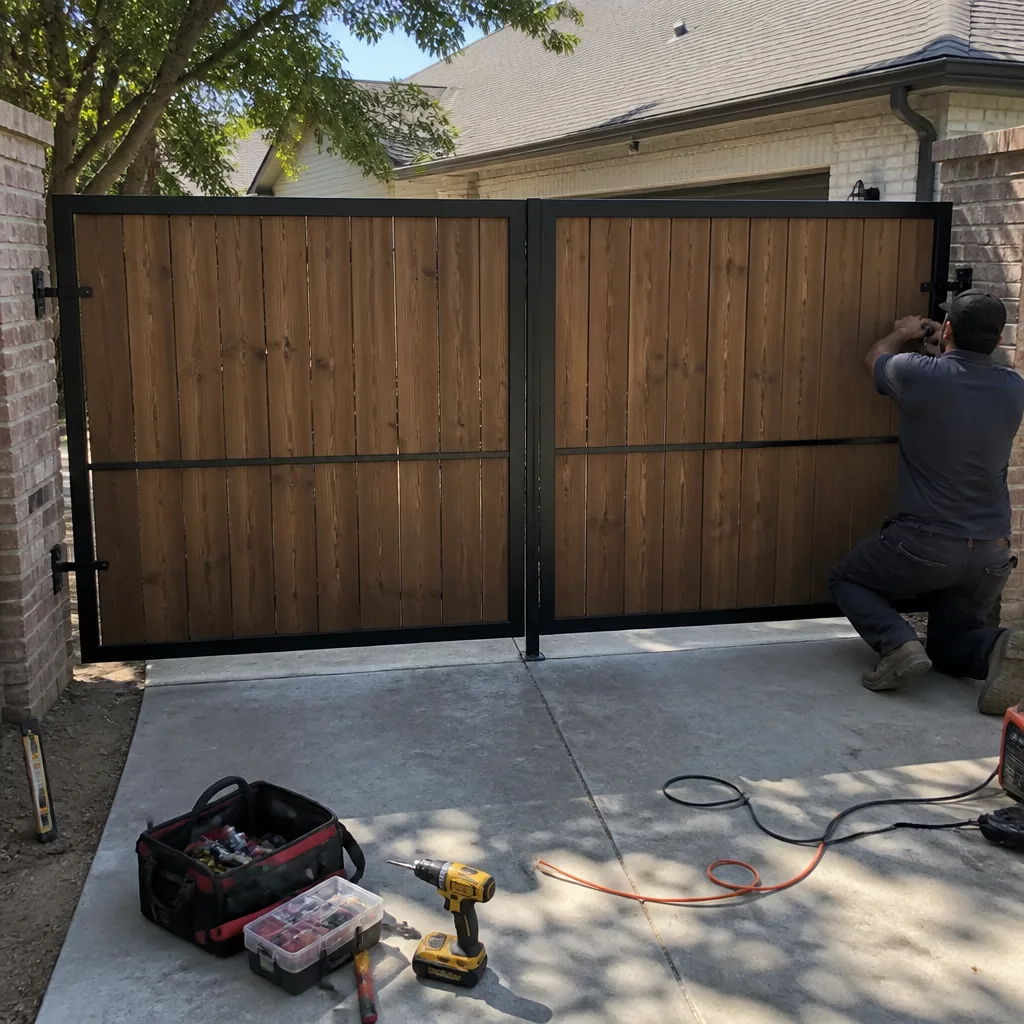 After
After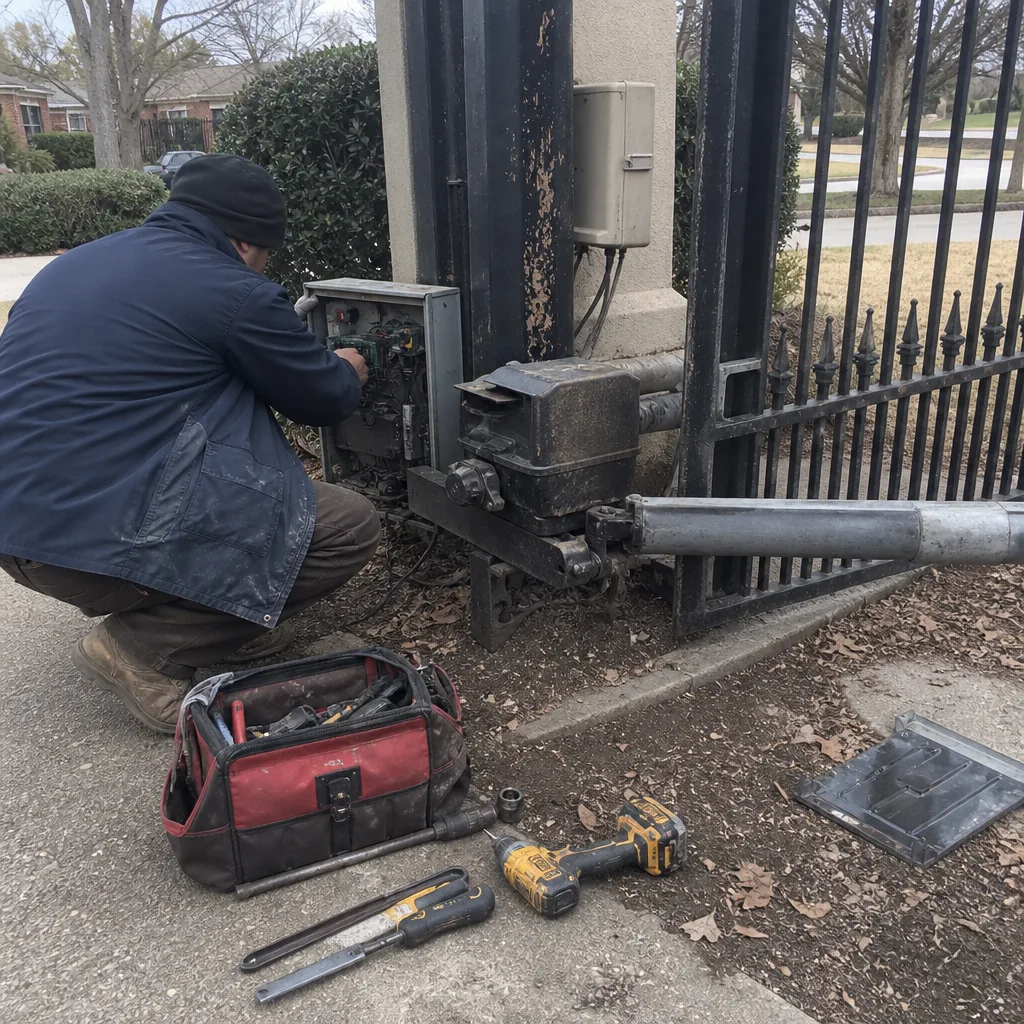 Before
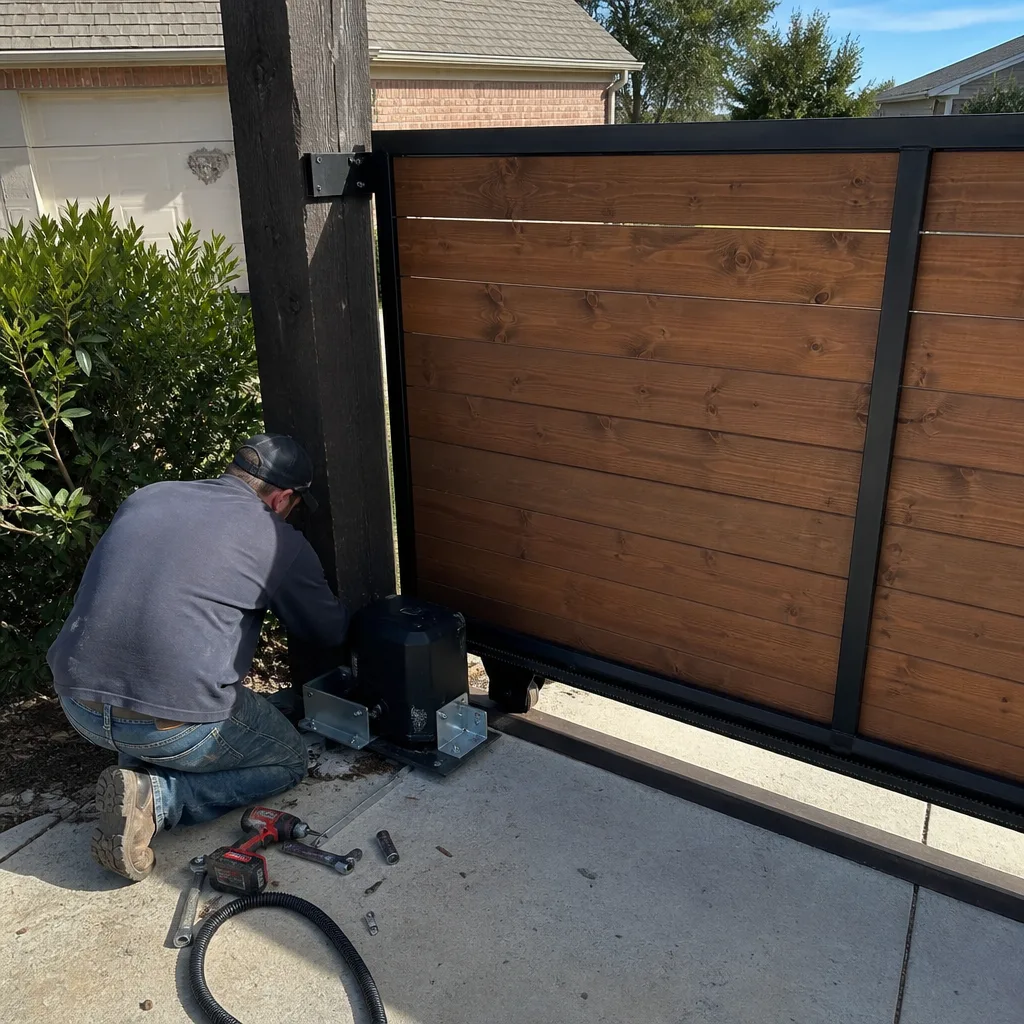 After
After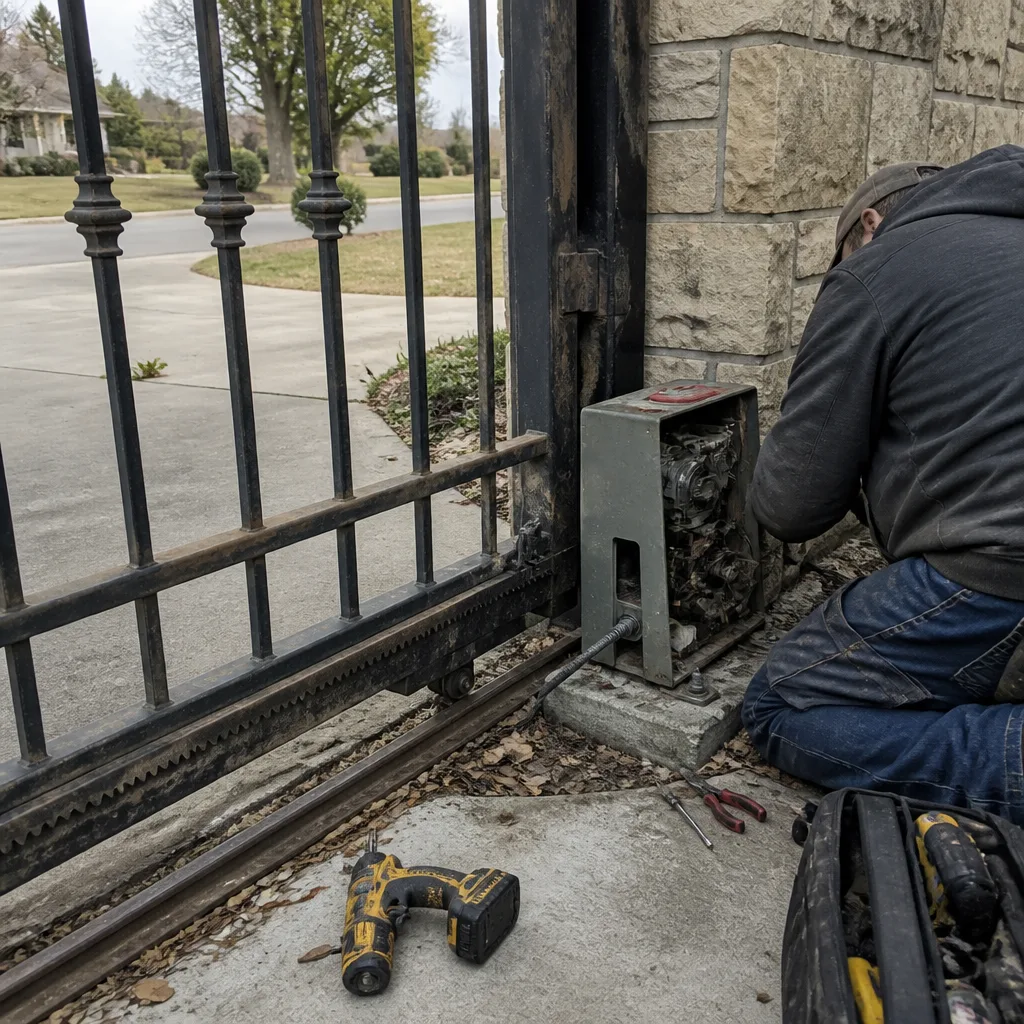 Before
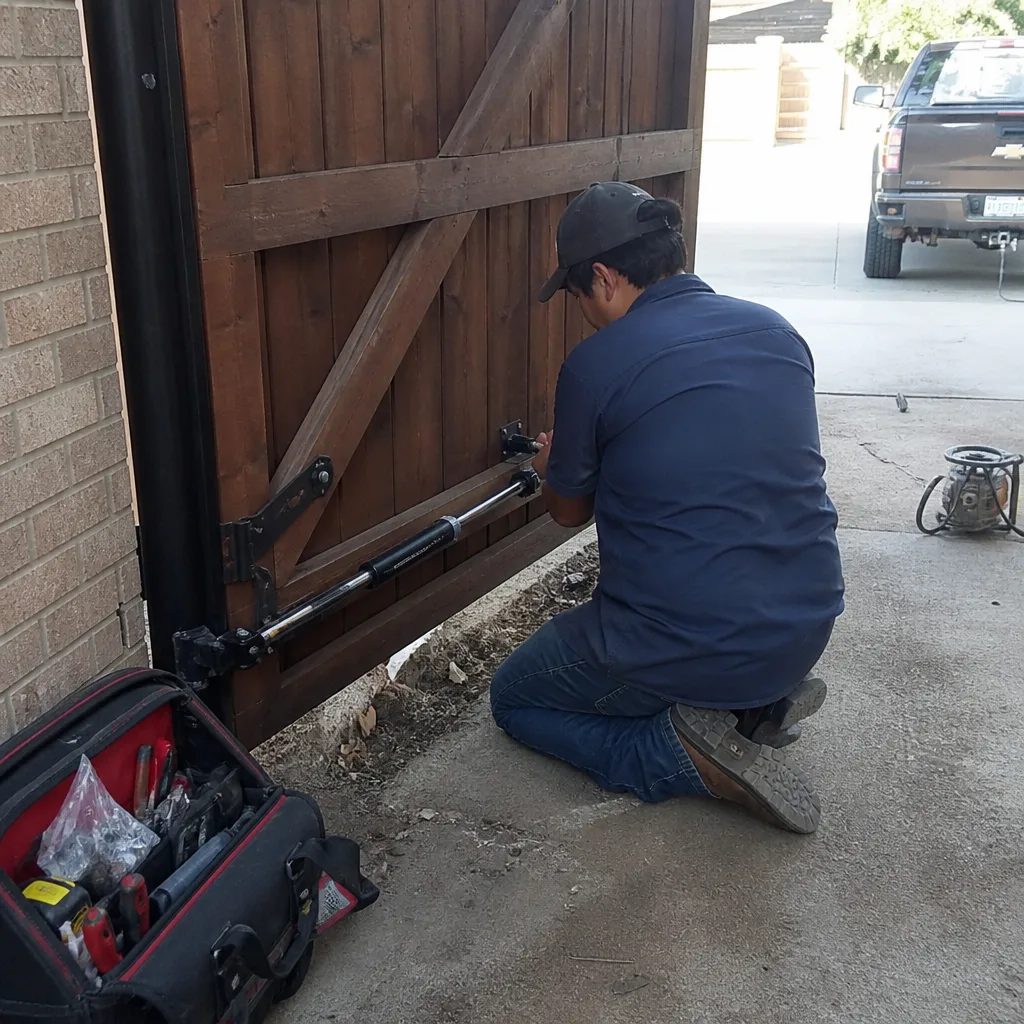 After
AfterGate Repair Maintenance Checklist for Prosper Homeowners
Here’s a number that surprises most people: roughly 80% of the gate failures we get called out for in Prosper were visible for months before the gate actually stopped working. A slight sag, a hesitation in the opener, a noise that wasn’t there last spring. The expensive part isn’t the final breakdown. It’s the chain of small decisions somebody didn’t make because a generic maintenance checklist said “lubricate moving parts” and left it at that. This guide is different. It’s built for Prosper’s actual conditions, the climate, the tree cover, the soil movement that makes local gates fail differently than gates two counties away. We’ll walk through what to check, when to check it, what to use, and what to leave alone.
Quick Answer
A practical gate maintenance routine for a Prosper homeowner is a 10 minute monthly visual and mechanical check of the hinges, post alignment, opener response, track cleanliness, and lubrication points, plus a deeper 20 minute seasonal check each spring and fall. The goal isn’t to become a gate technician. It’s to catch the two or three issues, post movement, debris packing, or a weakening capacitor, that cause the vast majority of gate failures before they become a service call that nobody wants to pay for.
Table of Contents
- Why Prosper Gates Fail Differently
- The Monthly 10 Minute Checklist
- Lubrication: The Right Product for Each Part
- Reading Your Gate Post Alignment
- The 30 Second Opener Test
- Debris and Track Clearing for Prosper’s Trees
- Photo Logging Your Inspections
- Seasonal Deep Checks
- Common Mistakes to Avoid
- When to Call a Professional
- Frequently Asked Questions
- The Bottom Line
Why Prosper Gates Fail Differently
Gate maintenance advice written for a generic national audience misses the specific things that happen in Prosper. We get clay soil here. When it rains, that clay swells and pushes against posts. When the summer heat bakes it for three straight months, it contracts and leaves gaps. That cycle puts a different kind of stress on a gate post than the sandy loam you’d find in other parts of Texas. It’s why we see more post movement and more hinge strain in this area than you’d expect from a gate that’s only a few years old.
The second factor is heat. A driveway gate in Prosper sits in direct sun for most of the summer. The metal expands. Electronics inside the opener housing get hot, even when the gate isn’t moving. Capacitors, which are the little electrical components that give a motor its starting kick, degrade faster in sustained heat. It’s a top reason a gate opener that works fine in March suddenly fails to move in July. It wasn’t sudden. The capacitor was cooking for weeks.
Finally, there’s the tree cover. Prosper has a lot of Bradford pears and live oaks. Both drop debris, small leaves, twigs, those little pear fruits, and all of it finds its way into track channels and hinge areas. A gate in an open pasture with no trees has a completely different debris profile. Understanding these three factors, clay soil movement, summer heat on electronics, and tree canopy debris, changes what a maintenance checklist needs to include.
The Monthly 10 Minute Checklist
Set a recurring reminder on your phone. The first Saturday of the month works for most people. Ten minutes. Here’s the exact sequence, in order, because the order saves you walking back and forth across the driveway.
- Visual sweep of the full gate from 15 feet back. Look for any change in the gap between the gate and the ground, especially at the latch end. A gate that used to have a 2 inch gap and now shows 1.5 inches on one side is telling you something about the post or the gate’s weight distribution.
- Stand at each hinge and watch while someone opens and closes the gate. You’re listening for creaks and watching for any wobble or movement at the hinge point itself. Movement at the hinge is fine. Movement where the hinge meets the post is not.
- Check the track channel if you have a sliding gate. Use a stick or screwdriver to scrape out any packed dirt or leaf matter. Don’t use your fingers. You’ll find ants, spiders, and occasionally a wasp that disagrees with your schedule.
- Run the opener through one full open and close cycle. Stand at the keypad or remote and watch. Does it hesitate before starting? Does it slow down halfway? Does it jerk? These are the early signs of a motor or capacitor issue.
- Check the safety sensors. On most automated gates, there’s a photo eye near the ground on each side. Make sure they’re clean and aligned. A leaf across one sensor is enough to stop a gate from closing.
- Test the manual release. This is the one step everyone skips. Pull the release handle and make sure the gate can be moved by hand. If you lose power in a storm, you’ll want to know that release works.
- Glance at the battery backup, if you have one. Note any warning light. Most batteries last two to four years in the Prosper heat. If yours is older than that, it’s borrowed time.
That’s the whole routine. If you do nothing else, do this. It catches more than 80% of the issues we find on service calls in Prosper.
Lubrication: The Right Product for Each Part
The most repeated piece of gate advice in existence is “lubricate moving parts regularly.” It’s not wrong. It’s just incomplete to the point of being useless. The wrong lubricant in the wrong place creates problems that are harder to fix than the ones you’re trying to prevent. Here is the breakdown for the specific components on most Prosper gates.
Chain drives: Chains do not need oil. Motor oil, WD-40, and penetrating oils are all wrong for a gate chain. They attract dust and grit, and in Prosper’s summer heat they bake into a sticky paste that makes the chain work harder. Use a dry film lubricant, something like a graphite spray or a dry Teflon lube. Brands like Blaster Dry Lube or DuPont Teflon Dry-Film are both available at local hardware stores in Prosper and both do the job. Spray the chain, let it dry, run the gate once, done.
Screw drives: A screw drive opener uses a threaded rod. It does need grease, but a specific kind: white lithium grease. A thin coat along the screw thread, applied while the gate runs one cycle. Do not over-grease. A heavy layer of lithium grease collects debris and turns to grime within a month.
Hinge pins: Hinge pins get a drop of actual oil or a spray of white lithium grease once every two or three months. A squeaky hinge on a gate may be telling you something else too. If the hinge is squeaking and the gate is also sagging, the lube is a band-aid on a post problem. More on that in the next section.
Wheels and rollers: Sliding gate rollers should be cleaned first, then get a shot of spray grease into the bearing, not onto the wheel surface. Grease on the wheel surface just collects what the gate rolls over. The bearing is the working part.
What we use: In my service truck, I carry dry lube for chains, white lithium grease for screws and hinges, and a spray bearing grease for rollers. That’s it. You don’t need a shelf full of products. Two or three specific ones, used in the right place, are worth more than a dozen generic sprays.
Reading Your Gate Post Alignment
This is the single most important skill on this checklist, and almost nobody does it. A gate sags in the hinge post, not in the middle. That’s a line I’ve said more times than I can count, because it’s true, and because it reframes where you should look. The gate panel itself, if it was built right, is rigid. If it’s sagging at the latch end, the hinge post has moved, or the gate has pulled away from the hinge, or the hinge itself has worn. Here’s how to check it before it becomes a structural repair.
The string-line method:
- Get a length of mason’s line or fishing line and two stakes or anything heavy that will hold a line taut.
- Run the string from the top of the hinge post to the top of the latch post, keeping it tight.
- Stand back and look at the string relative to the top edge of the gate. If the gate edge drops away from the string toward the latch end, you’ve got sag.
- Now move the string to the bottom edge of the gate and check again. A difference in the gaps tells you which side of the gate has moved.
- Repeat the check by sighting down the post itself. Put your eye near the hinge post and look straight up it. A post that is leaning will be visibly out of plumb. You don’t need a level; your eye is good enough to see a couple degrees of lean.
Also check the gap at the bottom of the gate at the latch end. In Prosper, a gate that opens and closes over a concrete driveway will often show a gap that widens or narrows seasonally as the clay soil moves. That’s normal in small amounts. What you’re watching for is a permanent change over several months. If the gap at the latch end has decreased by half an inch and stayed that way through a season, the post is moving and not coming back.
When you catch this early, the fix is often simple: reset the post, add more concrete, or add a brace. Leave it alone and the hinge side gets worse, the gate binds, the opener strains, and you get into a full replacement. Fix the panel without the post and you’ll fix it twice. That’s not a tagline. It’s a repair sequence I’ve seen happen dozens of times in Prosper.
The 30 Second Opener Test
This test catches the two most common opener failures before they strand someone outside the property: a failing capacitor and a weak battery. It takes half a minute and it’s done from outside the gate.
- Stand outside the gate with the gate closed. Use your remote or keypad to open it.
- Count the seconds between the moment you press the button and the moment the gate actually starts moving. On a healthy opener, that delay is under one second. On a failing capacitor, the motor hums or clicks for two, three, sometimes four seconds before it finds enough power to start. That hesitation is the capacitor charging and dying.
- Watch the speed and smoothness of the gate as it opens. A gate that starts fast and slows down dramatically halfway through the cycle is often a motor or capacitor issue, not a mechanical binding issue. A gate that starts slow and speeds up can be the same. Variation you can see is variation worth investigating.
- Close the gate by triggering the safety sensor manually. Wave your hand in front of the photo eye while the gate is closing. It should reverse immediately. If it doesn’t, that’s a safety failure, not a convenience issue. Close the gate and call us. That’s the kind of thing that should not wait.
- If you have a battery backup, unplug the opener or flip its breaker. The opener should continue to work on battery power. If it doesn’t, the battery is dead or dying. In Prosper, where storms can knock out power and leave a gate stuck open or closed, a dead battery backup is a real security problem.
The whole test takes under a minute. Do it once a month. It’s also a good way to catch the little things, a keypad button that’s getting temperamental, a remote whose range is shrinking, before you’re locked out or locked in. Show me the gate closing on its own and I’ll show you where it’s failing. Generally, I’ll show you where the issue has been visible for weeks.
Debris and Track Clearing for Prosper’s Trees
Prosper is not a bare suburb. We have mature Bradford pears, live oaks, pecan trees, and all of them shed. That debris, small leaves, twig fragments, pear fruit, acorn caps, pecan husks, ends up exactly where you don’t want it: in the track channel of a sliding gate, around the hinge pins of a swing gate, and under the gate itself. A gate that rolls over packed leaf matter grinds it into paste. A gate that swings through a pile of twigs drags them against the post. It’s a bigger issue here than in open-lot developments because the canopy is established and the debris is constant.
How often to clear by season:
- Spring (March through May): Every two weeks. This is Bradford pear blossom and fruit drop season, plus new leaf litter. The fruit especially packs into track channels and dries into something resembling concrete.
- Summer (June through August): Monthly. The heat dries everything out, but wind storms kick up whatever is lying around. Check after any storm with high wind.
- Fall (September through November): Every week during peak leaf drop. Live oaks are the big one in Prosper in the fall. Their small leathery leaves fit perfectly into track channels.
- Winter (December through February): Monthly, unless you have live oaks holding leaves through the winter, which is common here. Then keep up the every two week check.
Use a leaf blower for the driveway surface. Use a screwdriver, a trowel, or a putty knife for the track channel. A pressure washer is too much for most gate mechanisms, it forces water into bearings and electronics. For the hinge area of a swing gate, a stiff brush works. Don’t use your hands. I’ve mentioned this, and I’ll mention it again because every spring someone in Prosper reaches into a hinge box and meets a wasp.
Photo Logging Your Inspections
This is the step most homeowners never think to do until there’s already a problem, and then they’re trying to remember what the gate looked like eight months ago. Memory is unreliable. Photos are not.
Create a folder on your phone labeled with the gate, or just keep the photos in a dedicated album. Each time you do your monthly check, take four photos from the same positions every time:
- Full gate from 15 feet back, centered. This shows the overall condition and any sag.
- Close-up of the gap at the latch end. This is the gap between the gate and the ground at the latch side. If post movement is happening, this is where you’ll see it first.
- Close-up of the hinge or track area. Either the hinges on a swing gate or the track channel and rollers on a slide gate.
- The opener unit or motor housing. Catching a cracked housing, a loose wire, or a corrosion spot early is much cheaper than replacing the whole unit.
The value of this log is comparing change over time. When a repair tech, including the person who shows up from Gatewood Fence & Gate, looks at a gate that’s failing, the first question is always “when did this start?” A photo log answers that question with dates and evidence. It turns a vague sense that something has changed into a documented timeline. It also helps you make better decisions. If a salesperson tells you that the post needs replacing and the photos show the gap hasn’t moved in six months, you know to get a second opinion.
Seasonal Deep Checks
The monthly checklist keeps things moving. Twice a year, once in April and once in October, spend 20 minutes on a deeper pass. Prosper’s weather transitions in those months put specific stress on gates.
Spring deep check (April): Winter is over and the clay soil is drying out. The gate may have shifted during winter rain. Check post alignment using the string-line method. Inspect all wiring connections at the opener and keypad for corrosion or animal damage, and squirrels and mice love opener housings. Test the manual release thoroughly. Clean the photo eye lenses. Lubricate all lube points before the summer heat arrives. This is also the time to check that the gate closes fully and latches properly, because a gate that doesn’t latch in Prosper is a gate that will swing in the spring wind and strain the opener. If you’re planning any major work, review Gate Repair Permits, Codes & Inspections in TX: What You Need to Know first.
Fall deep check (October): Summer heat has had its way with everything. The capacitor has been cooking since June. Test the opener response time. Check the battery backup. Clean out the track channel thoroughly before fall leaf drop begins. Inspect the gate’s finish for any chips or scratches where winter moisture can start rust. In Prosper, the winter is mild enough that rust is not a huge problem, but any exposed metal on a gate fence combination will oxidize over time. A little touch-up paint once a year saves a lot of metal later.
These are the two checkpoints that keep a gate alive through the seasons that actually stress it. The monthly check is maintenance. The seasonal check is prevention.
Common Mistakes to Avoid
- Using WD-40 on everything. WD-40 is a water displacer with some light lubricating qualities. On a gate chain it becomes a magnet for grit. On a hinge pin it evaporates. On a screw drive it does next to nothing. Use the right product for the part.
- Ignoring a gate that’s getting slower. A gate that moves slower than it did last month is telling you something. It might be a dying capacitor, a straining motor, or a mechanical bind. Waiting until it stops entirely turns a simple fix into a full opener replacement.
- Lubricating without cleaning first. New lubricant on top of old dirt creates an effective grinding paste. Clean the part before you lube it. This matters especially on track channels and chain drives in Prosper, where the dust is fine and constant.
- Adjusting the gate yourself when the issue is the post. When a gate sags, homeowners often try to adjust the hinges or the latch. The issue is usually the post. Moving the latch or shimming the hinges masks the problem and half the time makes the gate worse.
- Forgetting to test the safety features. The photo eye and the auto-reverse are the two features that keep a gate from hurting someone. Testing them once a year is not enough. Monthly is the minimum.
- Not knowing where the manual release is. A gate stuck closed during a power outage is a problem. A gate stuck open is a security risk. Find the manual release before you need it. It’s usually a pull handle or a keyed release on the opener arm.
- Replacing the battery only after it fails. Backup batteries fail silently. You don’t know it’s dead until the power goes out and the gate won’t move. Check the battery’s age and test it when you do your monthly opener check.
When to Call a Professional
Some tasks on this checklist are safe for any homeowner. Cleaning a track, lubricating a hinge, testing the manual release, these are all fine. Others are not. Anything involving the high tension springs on a gate, the torsion assembly, or the wiring that feeds power to the opener should be left to someone trained and insured. A gate spring under tension can cause serious injury if it lets go. The same goes for any electrical work at the panel or the opener’s main power connection. If you see a cracked post, a gate that’s visibly leaning, an opener that hums but doesn’t move, or a gate that reverses randomly for no reason, that’s a job for someone who does this every day.
Gate Repair in Prosper from Gatewood Fence & Gate includes a full inspection of the posts, hinges, opener, and safety features. If the gate can be welded and repaired, we weld it, in your driveway, with the gate still on its hinges. We don’t haul it off to a shop unless that’s the only way to fix it. Estimates are free. The 90-Day Done Right Promise means if it’s not right, I come back and make it right, no runaround. Call (979) 291-0947 and I’ll be the one who answers, any time of day.
Frequently Asked Questions
Hinge pins and screw drives need lubrication every two to three months. Chain drives need dry film lubricant every three to four months. In Prosper’s summer heat, lubricants break down faster, so check more often from June through September. Clean the part before applying any lubricant. If you’re not sure which product to use on which component, call (979) 291-0947 and we’ll tell you exactly what to buy before you waste money on the wrong thing.
A sagging gate usually means the hinge post has shifted or the gate has pulled away from the hinges. It’s rarely the gate panel itself. Check the post with a string line. If you see movement, the fix is resetting or bracing the post, not adjusting the latch or shimming the hinges. Fix the panel without the post and you’ll fix it twice. That’s a repair we handle in Prosper regularly, and catching it early keeps it cheap.
Most gate repairs in Prosper fall between $150 and $600 depending on whether it’s a simple hinge replacement, a capacitor, a post reset, or a welded panel repair. A full opener replacement runs higher because the opener unit itself is the biggest cost. We quote the price before any work starts, and that’s the price. No surprises at the door. Standing offers: $40 off any repair over $200, a free second opinion on any written estimate, and a permanent 10% discount for seniors and veterans.
We service nine major brands: Linear, Viking, Ghost Controls, DoorKing, plus LiftMaster, FAAC, BFT, Elite, and Mighty Mule. If your opener is one of those, we have the parts and the experience to fix it. If it’s something else, call anyway and we’ll tell you honestly whether it’s worth repairing or whether replacement makes more financial sense.
First, check the manual release and see if the gate can be moved by hand. If it can, move it to the position that secures your property and then call us. Do not force a gate that won’t move, and do not try to bypass the opener’s wiring or electrical connections. The high tension springs and live electrical connections can cause serious injury. Call (979) 291-0947 and I’ll walk you through what’s safe to do while we get someone out to you.
Yes. We repair and install gate installations in Prosper of all types: driveway slide gates, driveway swing gates, walk gates, and ranch or field gates. The same maintenance principles apply across all of them, but each type has its own failure points. A ranch gate on a long fence line in Prosper has different post movement issues than a driveway gate in a subdivision. We look at the whole gate, the posts, the hinges, the opener, and the ground beneath it. For gate motor and opener service in Prosper, we rebuild what’s rebuildable and replace what isn’t.
The Bottom Line
Your gate in Prosper is a mechanical system, not a set piece. It moves. It wears. It sits in heat, dust, and tree debris. The homeowners who get the longest life from their gates are not the ones who bought the most expensive equipment. They’re the ones who spent 10 minutes a month looking at the gap at the latch end, listening to the opener, and cleaning the track. This checklist gives you that routine. If you find something on the list that you don’t want to handle yourself, or if you just want a set of experienced eyes on it, that’s what we’re here for. Gatewood Fence & Gate has been owner-operated since 2001, the name is on the shop, the shop is down the road, and the phone gets answered by a real person 24/7. Call (979) 291-0947 for a free estimate in Prosper.
Written by Hal Gatewood, Owner at Gatewood Fence & Gate, serving Prosper since 2001.